Instagram Bio Ideas for Language Tutors (That Get You Booked)
Written by LJ · Last updated October 9, 2026 · 10 minute read · 0 Comments
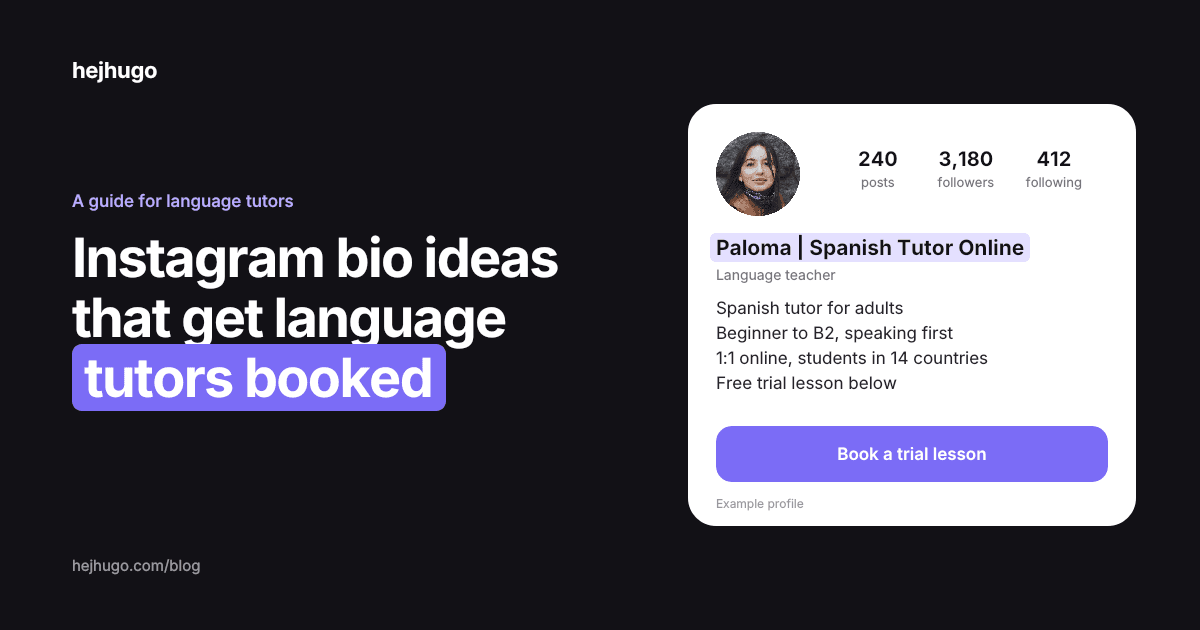
You have 150 characters.
That's the whole bio. Under a tiny profile photo, where a stranger decides in about four seconds whether you're worth DM-ing or not.
No pressure.
And then there's the voice in your head.
Who am I to say I'm "an expert"? Everyone writes "passionate language teacher." I am passionate. It still sounds like nothing. I don't have 10,000 followers. Why would anyone book me from Instagram?
Sound familiar?
You don't need a clever bio. You need a clear one. These Instagram bio ideas for language tutors all come from one formula, and you can write yours in about ten minutes.
What your Instagram bio is actually for
Your bio has one job.
It tells the right person "yes, this is for you" and gives them one next step.
It's not your resume. It's not your teaching philosophy. It's not the place for your three favourite quotes about language.
Think about who lands on your profile. Usually it's someone who saw a reel, got a recommendation, or typed "Spanish tutor" into search. They're curious, a little nervous, and probably comparing you to two other tutors in another tab.
They want to know three things:
-
Do you teach what I need?
-
Are you real, and good?
-
What do I do now?
Your bio answers those. Everything else is decoration.
The 150 characters (and the three fields most tutors mix up)
Instagram gives you a few separate spots, and they behave differently.
-
Name field. About 30 characters. This is the bold line at the top of your profile, and it's the one Instagram search leans on. Most tutors put just their name here. That's a missed chance. Put "Paloma | Spanish Tutor Online" and you're searchable for what you actually do.
-
Bio text. Up to 150 characters. Line breaks and emojis count toward that. Links typed in here aren't clickable, so don't waste space on a URL.
-
Link. Separate from the 150, and you can add up to five links, each with a short title. For a tutor, the first one should be a way to book a trial lesson. Not your homepage. Not your whole Linktree of eleven things.
One more thing. Your username is a different field again. Leave that alone unless it's a mess.
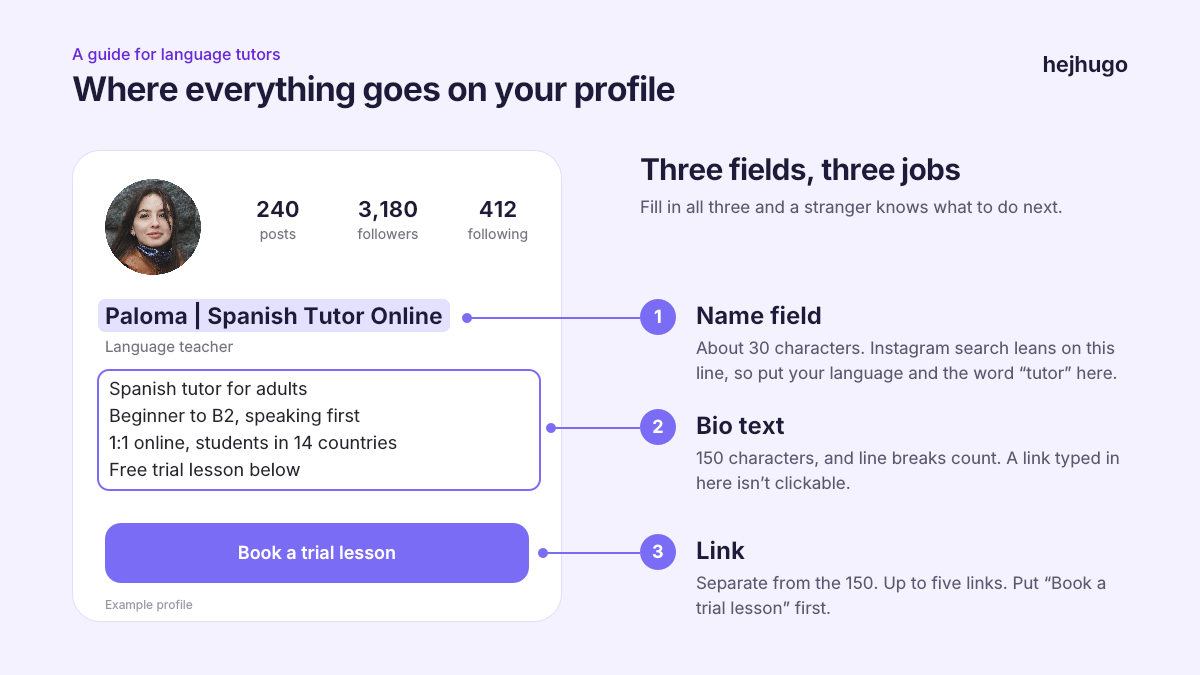 💜 A simple formula for a tutor bio
Four lines and each line does one job.
Line 1: who you teach, and what. "Spanish tutor for adults." Not "language lover." Say the language and the person.
Line 2: the level or the result. "Beginner to B2, speaking first." Something a student can picture.
Line 3: your proof or your difference. "Students in 14 countries." Or "no textbook drills." Or "homework you can do on the bus." One real thing.
Line 4: the next step. "Free trial lesson below." Tell them what to do. People follow directions more than we like to admit.
That's it. Who, level, proof, next step.
Notice what's not in there. "Passionate." "Dedicated." "Certified" with nothing after it. Those words are true for almost every tutor, so they separate you from nobody.
Specific beats impressive every time.
8 Instagram bio examples for language tutors (copy and edit) with real life examples
Copy them. Change the language, the level, and the proof. Every one of these is under 150 characters, line breaks included.
1. Spanish, for adult professionals 🇪🇸 (@martainspanish)
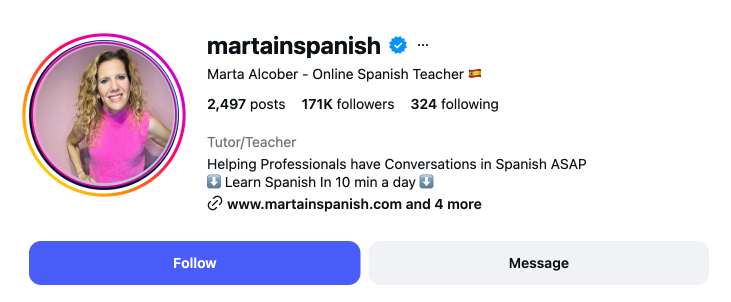 Name field: "Marta Alcober - Online Spanish Teacher." Plain and searchable.
The bio is two lines. "Helping Professionals have Conversations in Spanish ASAP" names the audience and the result. "Learn Spanish In 10 min a day" answers the biggest objection busy people have: "I don't have time."
She answers it before they ask.
Look at the link too. It says "and 4 more," so she's using the multiple links feature.
Steal this: put your students' biggest objection in the bio and answer it. "10 min a day." "No textbooks." "Any level."
2. English, for business professionals 👩🏻💼 (@speakupwithstephanie)
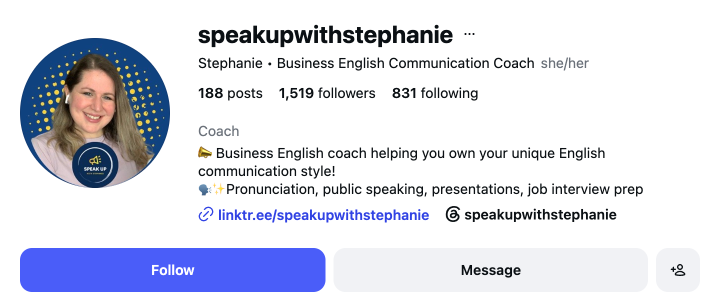 Name field: "Stephanie • Business English Communication Coach."
The bio lists the actual skills: pronunciation, public speaking, presentations, job interview prep. Someone who has an interview next week reads that and sees their problem named.
This one is a smaller account, with 1,519 followers, and the bio still tells you exactly what she coaches.
One thing you could add: there's no line saying what to do next, so the link carries all of it. Something like "Free intro call below" would close that gap.
Steal this: list the specific things you help with, in the words students use.
3. German, for people living, working and studying in Germany 🇩🇪 (@anna.deutsch)
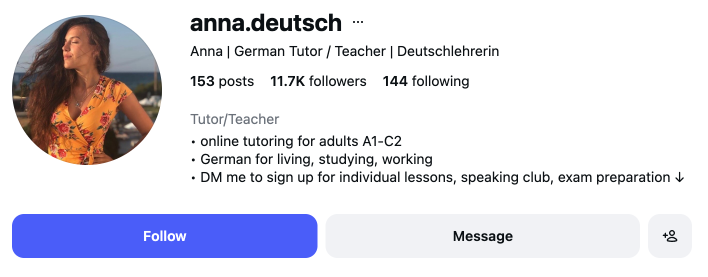 Start with the name field: "Anna | German Tutor / Teacher | Deutschlehrerin."
That one line covers two searches. Someone typing "German tutor" finds her. So does someone typing "Deutschlehrerin."
Then the bio. Online tutoring for adults A1-C2. German for living, studying, working. DM to sign up.
"Living, studying, working" is the smart part. It names the three reasons people learn German, so most people reading it see themselves in one of them.
She skips the link and asks for a DM instead. That works if you're happy chatting with people one by one.
Steal this: name the reasons your students learn, not just their level.
4. French, for people who love France 🇫🇷 (@frenchteachercarlitoo)
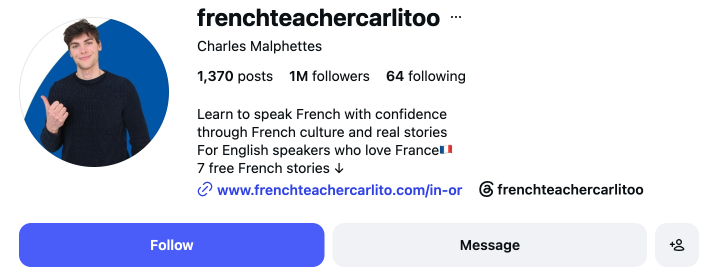 The name field here is a real name, so look at the username. "frenchteachercarlitoo" tells you what this account is before you read a word of the bio. If your name field is taken by your actual name, your username can do that job.
Then: "For English speakers who love France."
That picks an audience by what they love, not by what level they are. A beginner and an intermediate student can both fit it.
The last line is "7 free French stories," with the link right under it. A number gives people a concrete reason to tap.
Steal this: say who it's for in one line, then offer something free with a number in it.
5. Japanese, for professionals 🇯🇵 (@japanese_kanta)
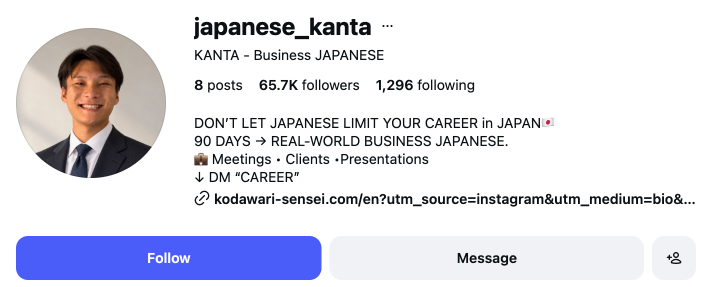 Name field: "KANTA - Business JAPANESE." The niche is right there. Business Japanese, not Japanese in general.
The bio gives a time limit: 90 days to real-world business Japanese. Then three situations a student can picture: meetings, clients, presentations.
And the next step is one word: DM "CAREER."
A one-word action is easy to do. It also tells you exactly who came from your bio.
Two honest notes. A 90-day promise is only worth making if you can keep it, so pick a timeframe that matches what your students actually get. And the link is long, with tracking text, so it gets cut off. A short link looks cleaner.
Steal this: give the person a one-word action instead of a paragraph of instructions.
6. Italian, spoken like locals 🇮🇹 (@lets.be.italians)
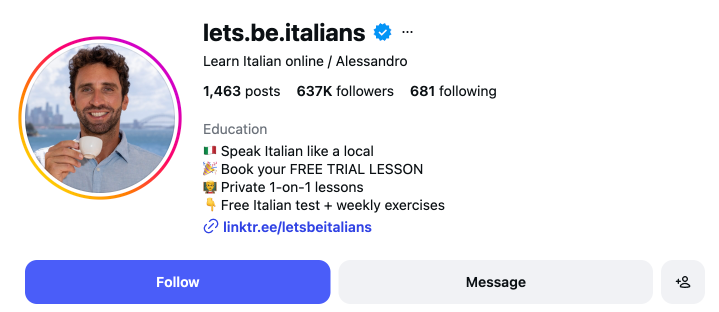 Name field: "Learn Italian online / Alessandro." Keyword first, name second. That's the order I'd use.
Four lines, each with an emoji bullet, each doing one job. Speak Italian like a local. Book your free trial lesson. Private 1-on-1 lessons. Free Italian test and weekly exercises.
The trial lesson is offered right in the bio. And there's a second door for people who aren't ready to book: the free test.
The emoji bullets make it easy to scan in a few seconds.
Steal this: give two ways in. Book now, or try something free first.
7. Portuguese, the way a student would say it 🇵🇹 (@portuguesewithbarbosa)
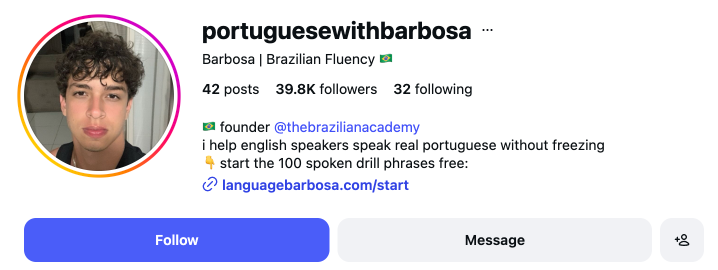 Name field: "Barbosa | Brazilian Fluency." Then the line I like best: "i help english speakers speak real portuguese without freezing."
"Without freezing" is the fear. Anyone who has gone blank mid-sentence in a second language feels that one. And "real portuguese" tells you this isn't textbook stuff.
The free offer is "the 100 spoken drill phrases," and the link ends in /start, so it's obvious what happens when you tap.
The lowercase, casual voice sounds like a person, not a school.
Steal this: describe the problem the way your student would say it out loud.
Two honest notes before you copy anything...
If you write "students in 14 countries" or "speak in lesson one," it has to be true. Use your real number. If you only have students from three countries, "students in 3 countries" is still proof, and a very believable one.
And if you're brand new and have no proof yet? Skip that line. Use that space for your difference ("lessons built around what you actually want to say") and add proof later. Nobody is checking your bio for a minimum number of students.
What all seven have in common
Seven bios, seven styles. Some use emojis, some don't. Some are bold, some are quiet.
They all say who they're for. German for living, studying and working. French for people who love France. Business Japanese for careers.
They all give one clear next step. A DM, a link, a free thing.
And they all use specific words. 90 days. 10 min a day. 100 phrases. A1-C2. Not "passionate." Not "dedicated."
The name field trick 🪄
This is the part most tutors skip, and it takes thirty seconds.
Your name field is searchable. Your bio text isn't weighted the same way. So if your name field just says "Paloma," you show up when someone searches Paloma. If it says "Paloma | Spanish Tutor Online," you also show up when someone searches for a Spanish tutor.
You have about 30 characters. Here are a few that fit:
-
Paloma | Spanish Tutor Online (29)
-
Spanish Tutor | Paloma (22)
-
German Tutor for Expats (23)
Count yours before you save. "English Tutor | Business English" looks fine but runs over, so it gets cut off.
And keep the keyword boring on purpose. "Spanish Tutor" will get searched. "Linguistic Adventurer" won't.
💡 Also worth noting, Instagram counts emojis as multiple characters, with some emojis like the teacher emoji 👩🏼🏫 (sadly) as 7!
Your link is half your bio
You can have up to five links now, and each gets its own short title, so please don't send people to a homepage and hope.
Put your trial lesson booking link first. Name it something plain, like "Book a trial lesson." If someone has to figure out where to click, they won't.
Everything else can sit underneath: your calendar, your lesson packages, one free resource. But the first link is the one that matters, and it should match what your bio just told them to do.
What to do after the bio works
Let's say it works. Someone reads your bio, taps the link, books a trial lesson.
Great. That's the easy half.
The harder half is what happens in the week after that lesson. Plenty of students book a trial and never come back. Not because the lesson was bad. Because nobody told them what comes next, and a week of silence feels like an answer.
That's a different post, and it's the one that decides whether your Instagram work pays off: How to turn trial lessons into regular students.
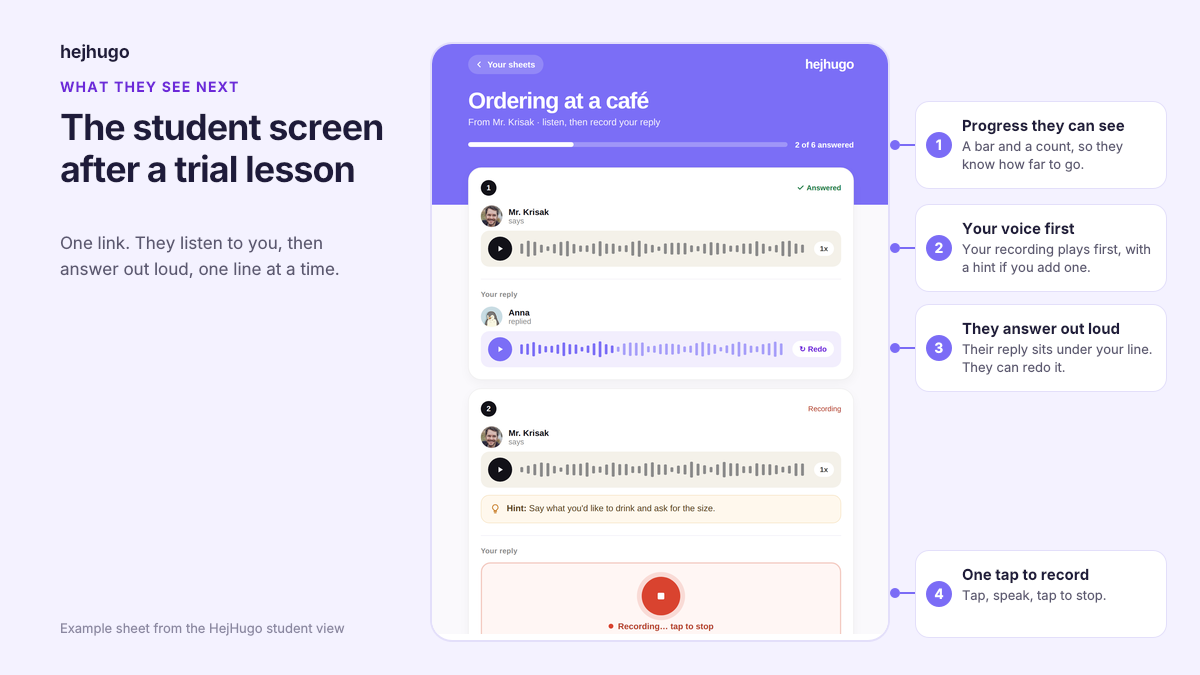 Try hejhujo for free for 14 days 👋🏼, see how your students like it (although my bet is they'll probably love it).
✨ Your turn (do this in ten minutes)
Don't wait until it's perfect.
-
Open your profile and look at it like a stranger would. What do you teach? Can you tell in four seconds?
-
Rewrite your name field with your language and the word "tutor."
-
Use the four-line formula and write your bio. Ugly first draft is fine.
-
Check it's under 150 characters, with line breaks counted.
-
Put your trial lesson link first.
That's it. Done is better than clever.
TL;DR Your bio has 150 characters, and its job is to tell the right student "this is for you" and give them one next step. Use four lines: who you teach, the level or result, one real piece of proof, and the next step. Put your language and "tutor" in the name field because that's the part Instagram search leans on. Make your first link a trial lesson booking link. Then make sure there's a plan for what happens after the trial.
0 Comments