How Your Students Can Practice Speaking Between Lessons (Without a Conversation Partner)
Written by Katarina P. · Last updated October 5, 2026 · 5 minute read · 0 Comments
Hej tutors, today I’ll share how I learned my first Afrikaans words.
When LJ and I first met online, we sent each other WhatsApp voice notes, teaching each other little bits of our languages. "Goeie môre" from LJ, "dobro jutro" back from me. Nothing too fancy, just a few seconds of talking out loud, every day.
It wasn't a course, and nobody was grading me (if they did I’m sure I’d do horribly). But because I was saying the words out loud, repeatedly, they eventually stuck with me.
Most of your students probably don't have that. They have their lesson with you, maybe once or twice a week, and then nobody to talk to until the next one. They might review vocabulary or do a worksheet you send them, but they rarely say anything out loud. So every lesson, you spend the first ten minutes getting them warmed up again.
Here's how to change that, with simple ways your students can practice speaking between lessons, even without a conversation partner handy.
The one-hour-a-week problem
Let’s do some quick math. In a 60 minute lesson, your student might actually speak for 20 or 30 minutes. The rest is you explaining, correcting, and giving examples. That's 30 minutes of talking out of 168 hours in a week.
Even the most motivated student can't build real speaking confidence on that.
I felt this in my intensive Czech classes. I'd get a full hour of talking with my tutor, leave feeling nice and confident, and then barely say a word of Czech until the next class. I could review vocabulary on the tram. Speaking, though, just faded. Each lesson, we'd end up going back over what we'd covered last time, and at times it felt like I was going in circles instead of moving forward.
Your students are probably feeling the same. It's not that they're not trying. They just have nowhere to practice out loud between lessons, so each lesson starts with catching up instead of building on the last one.
Solo speaking methods your students can try
The following are easy to suggest at the end of a lesson, and students can also do them from anywhere.
Talking to themselves, literally: Students describe what they're doing, out loud to themselves, in their target language, such as: making coffee, getting dressed, walking to the store. It feels a bit silly at first, but it builds the habit of finding the right words at the moment. It’s a good method for beginners, since they can stick to simple sentences.
Repeat after me: Students play a short audio clip, a podcast, a video, or even a recording from you, and repeat it right after, copying the pronunciation. It's especially good for students who understand a lot but sound choppy when they speak.
Voice diaries: Each day, students record a one-minute voice note about their day. Following no script, with no pressure. Over a few weeks, they can listen back and actually hear themselves improving, which is a big motivation boost.
All three work, and they're free. But they also have one big gap: nobody is listening. Students don't know if they're saying things correctly, so mistakes can linger. And without someone expecting their answers, it's easy to skip a day, and then a week.
This is where you come in.
Guided practice from you
Solo practice is a good start, but it works better when it comes from you, their tutor. Give your students a few speaking questions on the topic you just covered: their weekend if you taught past tense, ordering at a restaurant if you covered food. That they can then answer out loud, in their own time.
It doesn't have to mean unpaid work. Make a set of questions once and reuse it with every student who needs that topic. Then go through their answers together at the start of the next lesson, so it starts with progress instead of catching up.
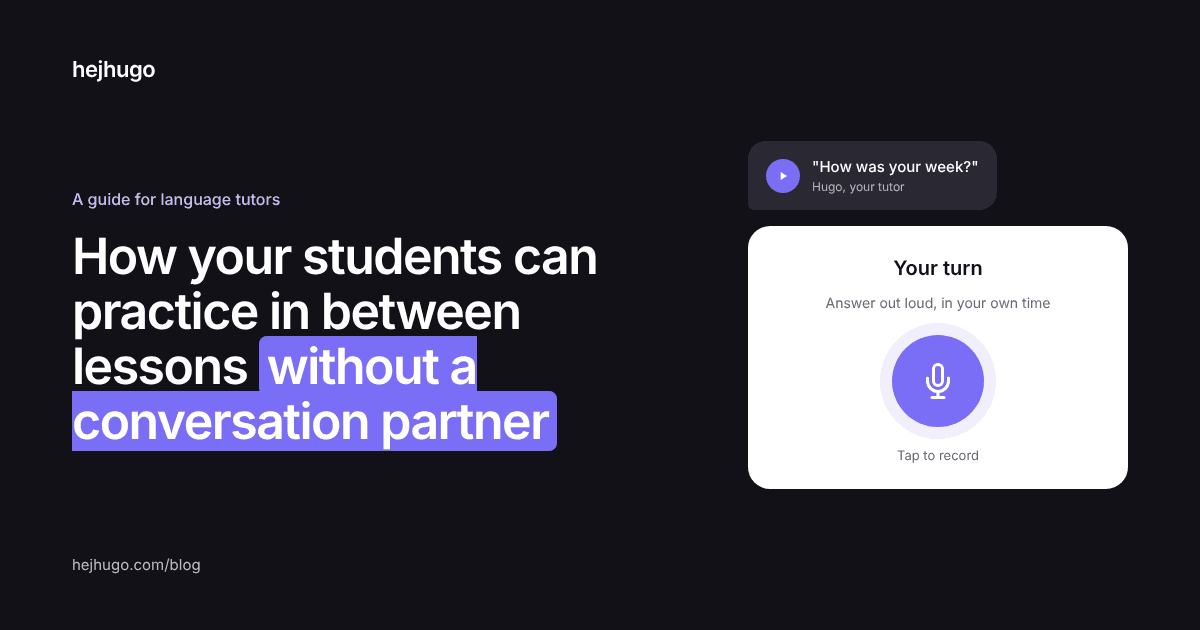
Voice notes can work, but they can get messy fast. You end up recording the same questions again for each student, and the answers get buried between other chats, and it's hard to keep track of who replied to what. HejHugo keeps it all in one place: record your questions once in your own voice, assign them to any student, and they answer out loud whenever it suits them.
Language exchanges and apps
Language exchanges are real conversations with a real person, which is hard to beat. But they take scheduling, and they can feel scary for beginners. Many students also find their partner only wants to speak English, or the chat drifts into small talk with no real direction. They're great for confident intermediate students, but harder for others.
Apps are good for vocabulary and for building a daily habit. But they can only take you so far. When I tried AI apps like TalkPal for Czech, I quickly noticed they taught phrases real people don't really use. It was the first time I'd ever heard "sbohem" for goodbye, and I’ve never heard any Czech person say that. My tutor had never taught it either, because people just say "ahoj" or "na shledanou." An app can't tell you what people actually say. But the tutor (aka you) can.
A 10-minute daily routine
Students don't need hours. Ten minutes a day is enough to keep them speaking and progressing between lessons. Here's a sample week you can send them as is, or adjust as you see fit:
Monday: Lesson day. Note one topic to practice this week.
Tuesday: Answer your tutor's speaking questions on that topic sheet sent through HejHugo.
Wednesday: Describe your morning out loud while you get ready.
Thursday: Pick a short clip from a podcast or video and repeat it, line by line.
Friday: Answer the same speaking questions again, and notice what feels easier.
Saturday: Record a one-minute voice diary about your week.
Sunday: Rest, or listen back to your voice diary.
Notice Tuesday and Friday. Answering the same questions twice lets students actually feel their progress, and they come to the next lesson with something tangible to talk about. With HejHugo, both answers sit on the same sheet, so you can listen to them side by side and hear the differences together.
0 Comments